The Future Is Complicated. I Want a Simpler Life.
I've noticed something interesting about the direction my life has been taking lately.
On one hand, I'm more enthusiastic about technology than I've ever been. Artificial intelligence, autonomous vehicles, distributed computing, space exploration, advanced communications, and the extraordinary things that are becoming possible almost overnight. I follow these developments closely, experiment with them, build with them, and spend a considerable amount of time thinking about where they're leading us.
On the other hand, I find myself increasingly drawn toward something that seems almost the exact opposite.
A piece of land. Some woods. A quiet place away from the noise. A little independence. Fewer obligations. More control over my time.
A place where I can sit outside in the evening, listen to the wind moving through the trees, and not particularly care what's happening in the rest of the world.
At first glance, those two desires might seem contradictory.
I'm beginning to think they're actually connected.
The World We Were Promised
For as long as I can remember, technology has been sold to us as a way to make life easier.
Computers would eliminate tedious work. Communications would bring people closer together. Automation would free us from repetitive tasks. The Internet would democratize information. Artificial intelligence would eventually help us solve problems previously beyond our capabilities.
And to a remarkable extent, all of that has happened.
The problem is that every time technology makes something easier, society seems to find a way to fill the newly available space with something else.
Email made communication instantaneous, so now we're expected to respond instantly.
Smartphones put the entire world in our pockets, so now the entire world demands our attention.
Computers made us dramatically more productive, but rather than working less, we often just produce more.
We built systems that allow us to be connected to practically everyone, everywhere, all the time.
And somehow, being unreachable for an afternoon has become a luxury.
Maybe the problem was never the technology.
Maybe it was what we decided to do with it.
The Strange Appeal of the Woods
I grew up around woods, creeks, back roads, open spaces, and places where the world seemed to move at a different speed.
There was something satisfying about that environment. Not because life was necessarily easier, but because it was more immediate. The things around you were tangible. You could see the results of your work. You could spend hours exploring without needing a destination or an explanation.
I've never entirely lost that connection.
These days, I find myself imagining a small place in the country, surrounded by trees, with enough room to breathe and enough distance from everything else to enjoy the silence.
But here's the interesting part.
I don't want to abandon modern technology to get there.
Quite the opposite.
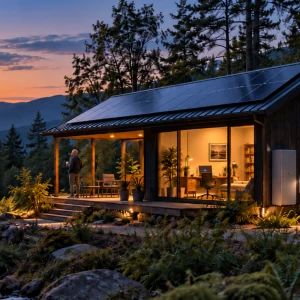
I imagine solar panels, batteries, satellite Internet, remote monitoring, sophisticated computing equipment, and the ability to work from practically anywhere. An electric vehicle that can handle much of the driving. Artificial intelligence helping me manage projects, maintain systems, and solve problems.
In other words, some of the most advanced technology available, quietly operating in the background of a very simple life.
That doesn't strike me as contradictory anymore.
It strikes me as the whole point.
Technology as a Means, Not a Destination
Somewhere along the way, I think we've confused technological progress with technological consumption.
We're constantly encouraged to buy the next device, adopt the next platform, subscribe to another service, and integrate another system into our daily routines.
But what if the greatest achievement of technology isn't how much of it we can incorporate into our lives?
What if it's how much unnecessary complexity it can remove?
Consider what has become possible for an individual today.
A single person can build and operate software systems that would once have required an entire team. They can communicate globally from a remote location, generate much of their own electricity, automate routine work, monitor property from hundreds of miles away, and access an almost unimaginable amount of human knowledge.
Things that once required enormous institutions, expensive infrastructure, or specialized personnel are increasingly becoming accessible to individuals.
That's a remarkable shift.
And while most of the conversation revolves around productivity, business opportunities, and economic disruption, I think there's another possibility that doesn't receive nearly enough attention.
Technology could allow us to become less dependent on the complexity it helped create.
Not completely independent, of course. Nobody manufactures their own microprocessors in a cabin in the woods. Solar panels, batteries, satellites, and computer networks all depend on enormous global systems.
But there's a meaningful difference between complete self-sufficiency and having greater control over the circumstances of your own life.
And that difference matters.
The Value of Being Able to Walk Away
For much of human history, where you lived largely determined what you could do.
You lived near your work. You depended on nearby institutions. Access to information, markets, and opportunities was constrained by geography.
Technology has gradually loosened those constraints.
And now, with remote work, satellite communications, increasingly capable automation, and AI, some of those limitations are disappearing faster than many people realize.
A person can participate in a global economy while living miles from the nearest town.
They can develop sophisticated products without maintaining a conventional office.
They can manage infrastructure in several locations without being physically present.
They can potentially organize their work around their lives rather than organizing their lives around their work.
That's the kind of progress that interests me most.
Not simply doing more.
Having the option to do less.
Or perhaps doing exactly what matters, without so much of what doesn't.
There's a certain freedom in knowing you can step away from the noise without stepping away from the world.
The Next Phase
I'm at an interesting point in life.
I've spent decades watching technology evolve, working with it, troubleshooting it, building systems, and adapting to changes that once seemed almost unimaginable.
And lately, the pace has accelerated to the point where developments that would have sounded like science fiction a few years ago have become ordinary subjects of conversation.
I find that exciting. I genuinely want to see what comes next.
But I also find myself thinking more seriously about how I want to spend the years ahead.
Not necessarily retiring. Not disappearing from society. Certainly not abandoning technology.
More like rearranging the relationship.
Continuing to build things, explore ideas, experiment with emerging technologies, and remain connected to the extraordinary changes taking place around us.
But doing more of it on my own terms.
Maybe from a quiet place surrounded by trees. Maybe with a computer connected to a satellite thousands of miles overhead, a vehicle charging from electricity generated on the property, and an AI system helping with work that once consumed entire days.
And maybe, when the work is finished, closing the laptop and walking down to a creek without a phone demanding attention.
There's something almost poetic about using some of humanity's most sophisticated inventions to recover a little of the simplicity we once took for granted.
Perhaps That's What Progress Should Look Like
I don't believe the future necessarily has to be a world of endless screens, constant notifications, larger cities, busier schedules, and increasingly complicated lives.
That's one possible outcome, but it isn't the only one.
The same technologies that make hyperconnected modern life possible could also give individuals unprecedented freedom to live differently.
To work from places they love.
To build things without asking permission from large institutions.
To maintain meaningful connections without being constantly available.
To enjoy the benefits of modern civilization without being consumed by its demands.
Of course, none of this happens automatically. Technology can just as easily create new dependencies as eliminate old ones. And real freedom still requires money, infrastructure, security, health, and a certain amount of good fortune.
But the possibility is there.
And perhaps that's the future worth pursuing.
Not a rejection of progress, but a more deliberate use of it.
Not escaping technology, but putting it in its proper place.
Not returning to the past, but recovering some of the things we valued about it while keeping the extraordinary capabilities of the present.
I've come to realize that my fascination with advanced technology and my desire for a simpler life aren't competing impulses.
They're two sides of the same idea.
I don't want less future. I want a future that gives me more freedom to live.
And if that future happens to include a little cabin in the woods, a good Internet connection, and a quiet evening under the stars, I think I'd be perfectly happy with that.


Discussion