Holding Back the Dark
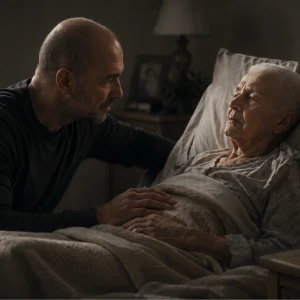
A little over a month ago, my parents reached their fifty-sixth wedding anniversary.
They did not celebrate it.
There was no dinner, no card, no private joke about the early years, no conversation about how long they had made it together. The date passed like any other day because my mother’s dementia has taken away her ability to understand what the anniversary means.
My father knew.
She did not.
That is the kind of loss dementia creates. It does not always announce itself with a dramatic moment. Sometimes it simply removes the meaning from something that should have mattered.
Fifty-six years still happened.
They were young once. They met, married, built a life, raised three sons, worked, worried, argued, laughed, paid bills, made plans, and lived through more changes than either of them could have imagined when they began.
There were decades when my mother was not a person who needed to be watched. She was active, independent, and fully present in her own life. She knew the people around her, understood the conversations happening in the room, and remembered names, dates, stories, routines, and all the small details that hold a family together.
She could make decisions. She could disagree with you. She could tell the same old story because she enjoyed telling it, not because she had forgotten telling it five minutes earlier.
My father was younger too. He was the one who went to work, solved problems, carried responsibility, and created the sense that the important things were under control. He was not someone I had to worry about after a brain hemorrhage or a fall. He was the person other people depended on.
For most of my life, my parents existed as a kind of fixed point. I grew up, left home, built a career, married, became a father, raised daughters, and created a life that belonged to me. I moved through different jobs, different cities, and different stages of adulthood while they remained in the background as Mom and Dad.
Their home was still there. They were still there. I could visit, talk, leave, and return to my own responsibilities without thinking too much about what kept their world running.
That is one of the quiet privileges of being someone’s child. You experience the stability your parents create without fully understanding the effort behind it.
Then life changes.
After my marriage ended, I moved back in with them. What began as a return home became many years, and during those years the direction of care slowly reversed. There was no single moment when I became responsible for helping hold things together. It happened gradually, through a small problem here, a forgotten task there, a concern that could no longer be ignored, and then another.
Because I work remotely, I was present during the day. That made it possible for me to notice things others might have missed. It also meant that my workday began to include responsibilities that had nothing to do with my actual job.
I work in technology. I deal with software, infrastructure, systems, security, websites, APIs, deployments, and the constant need to keep complicated things functioning. At the same time, part of me is always listening to the house: a door opening, the sound of a walker, a fall, or a room becoming too quiet.
I watch cameras. I check whether food has been touched. I pay attention to how much water has been drunk. I wonder how long I can leave the house and whether everything will still be all right when I return.
The work is different, but the instinct is the same.
Watch for failure. Recognize warning signs. Intervene before something becomes irreversible.
Technology usually gives you information. A system produces logs. Software throws errors. A network problem can be traced. A failed component can be replaced.
Dementia gives you none of that.
There is no status screen, no clear timeline, no warning that tomorrow a familiar task will become impossible. There is no way to restore an earlier version of a person. There is only the slow realization that something else has been lost.
People often say dementia takes memories. That is true, but it is not enough. It takes context, recognition, shared history, and the ability to understand why a particular day matters.
It can reduce fifty-six years of marriage to a date that only one spouse still recognizes.
My father is seventy-seven and still works full time. Mentally, he is still holding on. He remembers their life together. He understands what is happening. He knows the woman my mother was before dementia changed her.
That means he also knows exactly what has been lost.
He gets up and goes to work anyway.
Maybe work gives him structure. Maybe it gives him a place where things still operate according to recognizable rules. Maybe it is simply what he has always done, and stopping would mean admitting that the life he knew is no longer there.
Men of his generation often do not explain their burdens.
They carry them.
Over the past few years, my mother’s world has become smaller. Her food choices narrowed, her routines disappeared, and conversation became repetition. The house that had been familiar for decades became a place where she could no longer always be trusted to remain safe.
Recently, she began eating less. Then she stopped drinking enough. She became quieter and weaker.
The problem with living beside a long decline is that the abnormal gradually becomes normal. You adjust to one change, then another, then another. The line between manageable and dangerous keeps moving.
Eventually, I realized the situation had crossed that line.
I called 911.
The paramedics arrived and began asking questions. When had she last eaten? How much had she been drinking? How long had she seemed different? What was normal for her?
Those are difficult questions when normal has been disappearing for years.
They took her to the hospital. She was severely dehydrated, and her kidneys were beginning to suffer.
For a long time, the decline had seemed slow.
Then suddenly it was not.
That is the reality of caregiving. Most of it does not look heroic. It is made of small acts that barely register outside the home: making food that may not be eaten, refilling a glass that may remain untouched, checking a camera in the middle of the night, listening for movement while trying to work, postponing plans, staying close, repeating the same answer, and eventually making the difficult call.
It is watching someone you love become more dependent while knowing there is no path back to who they were.
There is grief in it, but it is a strange kind of grief. The person is still alive. She is still physically present. Her face is familiar. Her voice is familiar. Sometimes a look or reaction appears that belongs to the mother I remember.
Then it disappears again.
You grieve someone who has not fully left. You miss conversations while still sitting in the same room. You remember a relationship the other person can no longer remember with you.
And you keep going because there is no alternative.
The word entropy is often used to describe the natural movement of systems toward disorder. Things fall apart, energy disperses, structures decay, and nothing maintains itself forever.
I used to think of that as an abstract scientific principle.
Now I see it everywhere.
I see it in a body becoming weaker and a mind losing its connection to the past. I see it in an anniversary that passes without celebration, in a father carrying the memory of a marriage alone, and in a son arranging his life around the safety of the people who once arranged their lives around him.
But entropy is not the only force at work.
There is also maintenance.
Care.
Attention.
Love.
Love does not reverse dementia. It does not restore memory or return meaning to a date that has lost it. It does not make aging fair, and it does not prevent the eventual outcome.
What it does is create resistance.
A meal is resistance. A glass of water is resistance. A camera checked at midnight is resistance. A hospital visit is resistance. A husband remaining beside his wife after fifty-six years, even when she no longer understands what those years mean, is resistance.
A son staying close enough to hear when something goes wrong is resistance.
These acts are temporary. They do not defeat time. But they matter because the people receiving them matter.
For years, my parents spent their energy creating order for their children. They built the home, provided the food, carried the worries, and held the line while we grew up and moved into lives of our own.
Now some of that responsibility has come back to me.
There is no victory in the ordinary sense. There is no repair that returns everything to the way it was. There is only the choice to remain present, to preserve dignity where possible, to prevent suffering where possible, and to remember what another person no longer can.
Eventually, all systems fail. All lives end.
Entropy always gets the final word.
But it does not get every word before that.
Until then, there is work to do. There are meals to make, glasses to refill, doors to watch, memories to carry.
And one more day to hold the line.



Discussion