The Future That Never Leased
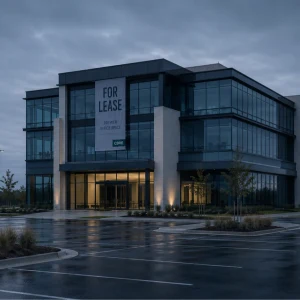
Fresh glass, leasing banners, and the haunting emptiness of offices built for a future that never moved in.
Some buildings become ruins after serving their purpose.
Others become ruins waiting for one.
The Buildings That Had Lives
The older ones are easier to understand. A factory closes. A mall loses its anchors. An office tower empties floor by floor as companies merge, shrink, remote-work themselves into smaller footprints, or simply vanish into the accounting fog.
Those places have ghosts because they had lives.
People clocked in there. Phones rang. Someone microwaved fish in the break room and was quietly hated for it by an entire department. Someone got promoted. Someone was fired. Someone sat in a parking lot for ten minutes before going home because the silence of the car was better than either destination.
A dead office, at least, has memory.
The Stranger Emptiness
But the newer empty offices are stranger.
Fresh paint. Perfect glass. New landscaping. Smooth asphalt. A leasing banner stretched across the front with a phone number nobody calls, except perhaps one man from a commercial real estate firm who has begun to sound spiritually tired.
Renderings still online show a bright future full of fake pedestrians, fake meetings, fake coffee cups, fake collaboration, and fake women in blazers laughing near a fake ficus.
The building is finished.
The future is not.
Built for a Spreadsheet Future
There are places like this now. Not everywhere. Not always obvious. Sometimes they sit near interstates, medical corridors, suburban growth zones, industrial parks, or the edges of towns that were supposed to become something larger once the correct number of orthodontists, regional managers, and compliance consultants arrived.
They were built for an economy that existed in a spreadsheet long before it existed on the ground.
Then the workers stopped coming.
Or they never came at all.
The developers imagined badge readers, conference rooms, lunch traffic, cleaning crews, package deliveries, copier leases, ergonomic chairs, and reception desks with bowls of individually wrapped peppermints that taste faintly of dust and resignation.
The city imagined tax revenue.
The bank imagined occupancy.
The architect imagined photographs at golden hour.
Everyone imagined movement.
How Square Footage Becomes a Place
But a building is not made alive by construction.
It is made alive by repetition.
Cars arriving in the morning. Lights turning on floor by floor. Elevators opening. Shoes in hallways. Annoying small talk. Office birthdays. Bad coffee. Private disappointments. Lunches eaten at desks. Friday afternoons when nobody wants to start anything new.
The thousand small rituals by which humans accidentally turn square footage into place.
Without that, a new building can begin dying before it ever begins living.
That is the haunting part.
An old ruin says: something happened here.
A new empty office says: something was supposed to happen here.
When Reality Declines the Calendar Invite
Maybe that is the more modern form of decay.
Not collapse after use, but failure before habitation.
A future projected, financed, permitted, constructed, landscaped, marketed, photographed, hashtagged, and then quietly declined by reality.
Remote work did not cause all of this, but it revealed the fragility of the old assumption. For decades, the office was treated almost like a natural law. People would always come. Workers would always need somewhere to gather under fluorescent light and pretend the meeting required a room.
Cities and suburbs were built around that rhythm.
Then the rhythm broke.
Fewer People, Fewer Chairs
Some workers went home and did not come back. Some jobs were automated. Some companies realized they needed less space than they had been paying for. Some people aged out. Some younger workers never developed the same loyalty to corporate geography. Some industries thinned. Some towns kept building as if the old tide would return.
But tides do not return simply because we built docks.
This is where population decline enters the picture quietly. Not as apocalypse. Not as a movie scene. Not as a dramatic shot of a child’s bicycle lying in the road while violins commit emotional fraud.
More like a slow mismatch between the world we built and the number of people available, willing, or able to use it.
Fewer children eventually means fewer students, fewer workers, fewer renters, fewer buyers, fewer office lunches, fewer new households, fewer people filling all the spaces we assumed would remain hungry forever.
Automation adds another layer.
If one person with AI tools can do the work of three, then the economy may still produce output, but it may not produce the same human traffic. The spreadsheet survives. The parking lot empties.
A business can become more efficient and less embodied.
That sounds like progress until you look at the buildings.
The future, it turns out, may not need as many chairs.
This is bad news for chairs, which have historically depended on humans having to be somewhere against their will.
Too Complete to Admit It Was a Guess
So the new office sits there.
Too new to be nostalgic.
Too empty to be useful.
Too expensive to abandon honestly.
Too complete to admit it was a guess.
It waits in that strange middle condition: not ruined, not alive, not yet repurposed, not yet forgotten. The grass gets taller at the edges. The parking lot stays clean longer than it should. The sign fades.
The website remains optimistic, because websites are among the last things to understand death.
A few lights stay on at night, maybe by timer, maybe by hope.
And for a while, from the road, it still looks possible.
That is the cruel beauty of it.
Capacity Without Demand
A dead mall announces itself eventually. The weeds break through. The anchor signs come down. The roof leaks. The escalators stop. Everyone knows the era has passed. At some point even the mall walkers stop pretending the place is just “between tenants.”
But an unleased future can hide in plain sight.
It can still look like tomorrow from fifty yards away.
Only closer do you notice the absence.
No fingerprints on the glass.
No worn path through the lobby.
No cigarette butts near the side entrance.
No tired woman in scrubs eating lunch in her car.
No IT guy with a badge clipped to his pocket, carrying a laptop bag and wondering whether the server closet is too warm.
No receptionist secretly reading real estate listings.
No middle manager using the phrase “circle back” as if summoning a minor demon.
No people.
Just capacity.
And maybe that is one of the defining images of this age: capacity without demand. Buildings without occupants. Systems without users. Futures without enough humans to inhabit them.
We are surrounded by older places that have died.
But now we are also building places that may never fully live.
The older build of America left ruins after the factories closed, the malls emptied, and the downtown towers lost their tenants.
The newer build may leave something even stranger.
Pristine ruins.
Unhaunted ghosts.
Buildings that never became places.