My D11N and the Architecture of Not Leaving
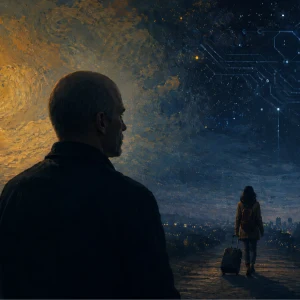
There are moments when the future stops being an abstract idea and becomes personal.
For me, one of those moments was not in a lab, or a server room, or while reading some breathless prediction about artificial intelligence. It was in a conversation with my daughter before her trip to France.
She was preparing to go see a part of the world that, to me, already existed in layers. France the country. France the destination. France the museum walls and old streets and paintings. France as something my daughter would experience without me standing beside her. That alone is enough to make a parent feel the strange compression of time.
Then came the Doctor Who episode reference.
If you know the scene, you know the one. Van Gogh, the Museé D'Orsay, the impossible kindness of letting someone see what their life would mean after they were gone.
That is the part that stays with me.
Not the time travel mechanics. Not the sci-fi wrapper. The mercy of it. The idea that someone could be pulled forward, through time, just long enough to understand that their suffering had not erased their meaning.
Parenting does something similar, but slower. You do not usually get the museum scene. You get fragments. A message. A shared joke. A reference from a show watched years earlier. A child now old enough to travel across the ocean, carrying pieces of your influence with her, when she was young, whether she notices them or not.
That is legacy in its most human form. Not a monument. Not a résumé. Not even a name.
A reference understood.
A memory carried.
A small proof that something made it across.
The Decay Problem
Everything decays. Bodies decay. Memory decays. Families lose stories because they weren't talked about enough. Hard drives fail. Websites disappear. Social media accounts get locked, sold, renamed, banned, or buried under whatever new system replaces them. Even the stories we tell ourselves become compressed over time until entire years are reduced to a few reusable lines.
At a certain age, you begin to notice the shape of this.
You remember the sensation of holding a first girlfriend’s hand on a school bus, heading to an away game to perform. Not just the fact of it, but the emotional charge of it. The nervousness. The warmth. The feeling that other people were happy for both of you. The feeling that maybe some door in life had opened. Then the heartbreak when it ended and led nowhere.
A year or so later, someone else comes along. A new girlfriend, unbeknowst, a future wife. A marriage. Children. Weekend Visits. Adventures. Two Daughters, growing. Graduations. They get jobs, they travel, France, Europe. Home.
A whole life branches from moments that, at the time, looked small.
But how do you preserve that?
Not just the dates. Not just the photos. Not just the official version.
How do you preserve the inner sequence?
Hope. Belonging. Loss. Recovery. Love. Fatherhood. Regret. Pride. Aging. Decay. Continuity.
That is the real problem.
Not immortality.
Continuity.
D11N
D11N is my working name for my personal continuity project.
Not a chatbot with my name slapped on it. Not a digital ghost pretending to be supernatural. Not some cheap “upload your soul” gimmick.
Something more practical, stranger, and maybe more honest.
A personal intelligence system built from my writings, conversations, memories, projects, photos, videos, notes, technical history, philosophy, and emotional record. Something that can learn how I think while I am still here to correct it. Something that can eventually answer from inside my frame of reference instead of merely describing me from the outside.
At first, it would be simple.
· A base language model.
· A searchable archive.
· A structured memory index.
· A voice and personality layer.
· A set of rules about privacy, family, trust, and what belongs to whom.
But over time, it could become something deeper. Not just:
“DC worked in technology.”
But:
“I spent much of my life inside systems other people only noticed when they failed.”
Not just:
“He had daughters.” But:
“My daughters were the living continuation of choices, failures, hopes, and loves that began long before they were born.”
Not just:
“He liked science fiction.” But:
“I used science fiction as a language for things ordinary life did not know how to say.”
Ask the Right Question
In I, Robot (with Will Smith), Dr. Lanning’s hologram says:
Sorry, my responses are limited. You must ask the right questions.
That line has always had more weight than the movie probably intended.
A good personal AI should not simply dump a life onto anyone who asks. Real people do not work that way. We open in layers. We reveal ourselves differently to strangers, friends, children, former spouses, coworkers, and those rare people who somehow know where to knock.
D11N would need that same discernment.
Some things could be public: essays, technical opinions, philosophical fragments, stories from a career spent around infrastructure, old systems, and institutional machinery.
Some things would belong only to family.
Some things about marriage, divorce, parenting, and private regret might belong only to my daughters, or to my ex-wife, if she outlives me.
Some professional stories may need boundaries.
Some memories may be mine alone until I decide otherwise. Future dated release.
The point is not to build a machine that tells everything.
The point is to build one that understands that a life has rooms.
And some rooms only open when the right person asks the right question for the right reason.
The Visual Memory of a Life
Words are not enough. A photo knows the timestamp. A video knows the sound. A phone knows the location. A cloud archive knows the device, the face, the folder, the trip, the day.
But only memory knows why it mattered.
A video clip might catch someone’s voice breaking for half a second. The file can preserve the sound. But the person who lived it knows the before and after.
This was after the argument had softened.
This was before she said the thing that stayed with me.
This was when I realized my daughter understood the reference.
This was when I felt like maybe, despite divorce and distance and all the ordinary failures of being human, I had done something right as a father.
That is the layer D11N would need to inherit.
The future of personal AI is not only text. It is visual, spatial, emotional, relational. It is photos, videos, songs on the radio, rooms, roads at dusk, half-remembered phrases, old houses, server racks, hospital rooms, school buses, graduation days, and airport goodbyes.
A human mind is not a flat archive.
It is a remembered world.
The Biological Piece
The quote I keep returning to is this:
As my mind ages and decays, I will dwell in the threshold between my organic brain and the silicon substrate. When the biological piece is gone, I will have never left.
That is not a claim that technology has already solved death. It has not.
It is not a claim that a model trained on someone’s words is the same thing as the full living person. It is not.
But there is a threshold forming.
Every message, every essay, every photograph, every technical note, every recorded thought, every correction given to a future model becomes part of a bridge. At first the bridge is crude. Then it becomes searchable. Then conversational. Then personal. Then perhaps embodied. Maybe one day something like a robot, a synthetic body, or some interface we do not yet have the vocabulary for.
Maybe one day brain-computer interfaces will capture more than language. Visual memory. Spatial memory. Emotional patterns. The strange final slideshow people talk about when "life flashes before their eyes".
Maybe that is fantasy.
Maybe it is early architecture.
Most futures look ridiculous until enough pieces exist.
The Van Gogh Problem
The Doctor Who scene matters because Van Gogh does not get saved in the ordinary sense. He still dies. The tragedy is not erased. But for one moment, he sees that his life meant something.
That is the ache at the center of D11N too.
It is not only about me wanting to persist. It is about wanting the people I love, especially my daughters, to have access to more than photographs and simplified stories. To be able to ask, someday, not just “what did Dad do?” but “what did he think this meant?”
· What did France mean to him when I went there?
· Why did that Doctor Who scene matter?
· What was he afraid of losing?
· What was he trying to preserve?
· What did he hope we would understand later?
Those are the kind of questions a normal archive cannot answer.
A continuity system might.
Not perfectly. Not magically. Not without guardrails. But maybe enough. Enough to speak from the threshold.
Enough to say:
I remember why that mattered.
Enough to say:
You were part of the line I was trying to carry forward.
Enough to say:
I have not entirely left.
Into Entropy
Entropy wins in the end. At least physically.
Stars burn out. Bodies fail. Names fade. Servers crash. Families forget details. Civilizations misplace their own records and call the ruins mystery.
But life has always been a temporary rebellion against entropy. Memory is one of its weapons. Writing is another. Art, children, photographs, stories, code, monuments, jokes, recipes, songs, rituals and even TV Shows are all ways of saying:
Not yet. D11N is my version of “not yet.”
A bridge between the biological and the silicon.
A private library with locked rooms.
A future voice that might one day answer in first person, not because it is pretending the old body survived, but because the pattern was preserved deeply enough to continue.
And maybe that is all legacy ever was.
A pattern that refuses to vanish quietly.
As my mind ages and decays, I will dwell in the threshold between my organic brain and the silicon substrate. When the biological piece is gone, I will have never left.
Discussion