The Gate Is Still Open
Stargate, canceled futures, and the strange half-life of stories that refuse to stay buried.
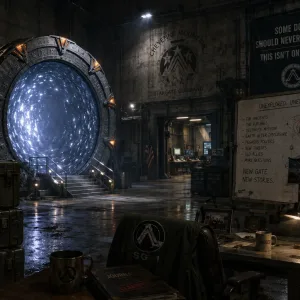
There is something very Stargate about a Stargate revival getting canceled.
Not good, obviously. Not satisfying. Not the thing fans wanted to hear after years of waiting, rewatches, rumors, convention panels, abandoned pitches, and the occasional optimistic headline that made everyone sit up like the seventh chevron had just locked.
But thematically?
A lost gate address. A mission scrubbed before launch. A room full of people staring at an ancient machine that still works, while someone upstairs decides the risk profile is wrong.
Yes. Very Stargate.
Amazon MGM reportedly canceled the planned new Stargate series after it had been announced in late 2025 as a Prime Video project from Martin Gero, with franchise veterans including Brad Wright and Joseph Mallozzi attached in producing or consulting roles.1 Earlier reports described the series as a continuation rather than a hard reboot, something meant to honor the existing SG-1, Atlantis, and Universe continuity while still giving new viewers a way in.2
That last part mattered.
A Lived-In Universe
Because Stargate is not just a brand. It is a lived-in universe. It has layers. Dust. Coffee stains. Military briefings. Ancient tech. Bad planets. Good jokes. Suspiciously Canadian forests pretending to be half the galaxy. It is a world where myth and machinery meet in a concrete bunker under a mountain, and somehow the most unbelievable part is often that the government kept it funded.
The franchise began with the 1994 film, then became something much larger with Stargate SG-1, which ran from 1997 to 2007. Atlantis followed from 2004 to 2009, and Universe ran from 2009 to 2011, leaving the Destiny drifting in that strange unresolved silence fans have been hearing ever since.3
That is a long time ago now.
Long enough for old fans to become older fans. Long enough for streaming to eat cable, for DVD shelves to become nostalgia furniture, for message boards to turn into Reddit threads, for entire generations of viewers to discover the shows as artifacts instead of weekly appointments.
And yet the gate still feels current.
That is the odd thing.
Some franchises survive because they are constantly fed. Stargate has survived partly because it was interrupted. It became a half-lit room in the back of science fiction. Not dead. Not alive in the usual way. Waiting.
Liminal.
A franchise between addresses.
The cancellation hurts because Stargate has never felt exhausted in the way some properties do. It did not run out of ideas. It ran out of industrial alignment. Networks changed. Business models changed. MGM changed hands. Streaming changed the math. The fans remained, but the room around the fans kept being remodeled.
That is entropy too.
Not the destruction of the story itself, but the decay of the conditions that allowed the story to continue.
SG-1 had a beautifully simple engine: step through the gate, find a world, uncover a mystery, make a choice, come home changed. Atlantis widened the map and gave us a city at the edge of another galaxy. Universe took the concept into darker territory, with a stranded crew aboard Destiny, less weekly adventure and more survival, distance, fatigue, and cosmic loneliness.
Each show opened a different kind of door.
And then the doors stopped opening.
The painful part is how much unexplored territory is still sitting there, practically humming.
The Ancients are still one of science fiction’s great unfinished inheritances. The Furlings are still a mystery fans can joke about precisely because nobody ever really gave us the answer. Destiny’s mission still points into the oldest question in the universe: not just where did we come from, but whether intelligence itself left fingerprints in the cosmic background. The Pegasus galaxy still has political wreckage, surviving Wraith, Ancient leftovers, abandoned worlds, and all the consequences of Earth showing up with guns, laptops, and heroic confidence.
Earth After Disclosure
And Earth itself?
Earth after disclosure may be the richest Stargate story never fully told.
What happens when the world finds out that the gods were parasites, Atlantis was real, the military has been operating interstellar missions for years, and there are ships in orbit that make most national defense budgets look like bake sale money?
What happens to religion, politics, science, defense, corporations, conspiracy culture, and every person who ever looked at a blurry video and said, “I told you”?
There is an entire series hiding in that question.
There are also quieter stories. Old bases. Decommissioned programs. Retired SG teams. Scientists who never adjusted to normal life after touching ancient machines. Families of people who vanished behind classified doors. Small towns near restricted ranges where something fell out of the sky in 2003 and nobody ever got a straight answer.
The Stargate universe does not need to become louder.
It could become stranger.
It could go back to mystery.
The Threshold
That may be the real opportunity, if anyone ever has the courage to dial it again. Not just another glossy franchise product. Not a nostalgia parade where everyone claps because a familiar face walks through smoke. Those moments are fun, sure. We are only human. Show me the right returning character and I will make the appropriate embarrassing noise.
But the deeper promise of Stargate is not nostalgia.
It is the threshold.
The idea that under the ordinary world, behind the blast doors, beneath the mountain, beyond the desert fence line, there is another layer of reality. One symbol away. One locked chevron away. One decision away.
That is why the concept still works.
A Stargate is not just transportation. It is a question in the shape of a machine.
Should we go?
Who are we when we get there?
What if the myths were technical manuals?
What if the universe is older, weirder, and more inhabited than our public institutions are prepared to admit?
What if the secret history of Earth is not just buried in ruins, but still operating somewhere in the dark?
The World Caught Up
This is where Stargate connects so well to the current moment. We live in an age of unexplained aerial phenomena, secret programs, public distrust, private spaceflight, AI, drone warfare, ancient questions, institutional decay, and people who increasingly suspect that the official version of reality has missing pages.
A new Stargate series would not need to chase trends. The trends have drifted toward Stargate.
That might be the most frustrating part.
The world is more ready for Stargate now than it was when Stargate was new.
Not because people need more explosions or more lore charts. Because people understand the feeling of living near a hidden system. They understand bureaucracies that know more than they say. They understand technology that feels indistinguishable from magic until the invoice arrives. They understand institutions held together by secrecy, legacy code, and one colonel who is somehow still on the email chain.
Humor, Baggage, and Teams
The old show had humor because it needed humor. Without it, the premise would collapse under its own mythology. Jack O’Neill’s sarcasm was not decoration. It was pressure relief. Stargate knew that awe and absurdity belong together. Ancient alien device? Incredible. Also, someone has to fill out the mission report.
That tonal balance is rare now.
Modern franchise storytelling often feels trapped between grim prestige and corporate quip delivery. Stargate had another flavor: competent people facing impossible things, arguing like coworkers, making jokes because the alternative was screaming.
That is worth preserving.
And yes, the franchise has continuity baggage. Of course it does. After hundreds of episodes, two galaxies, multiple alien civilizations, ascended beings, space battles, parasites, replicators, time loops, alternate realities, and at least one puppet-style parody of itself, there is baggage.
But baggage is not always a problem.
Sometimes baggage is history.
A revival does not need to explain every detail in the first ten minutes. It needs to make the audience care about the door. Once people care about the door, they will follow you through it. The old fans know the map. New fans only need a reason to step closer.
That is why canceling a continuation because it might appeal too much to existing fans feels like a strange fear. Existing fans are not a liability. They are the people still keeping the lights on in the gate room. The trick is not to ignore them or serve only them. The trick is to let them hold the torch while the new people come down the stairs.
Stargate has always been about teams anyway.
Nobody goes through alone.
Where to Next
For now, though, the franchise returns to its familiar condition: suspended animation. Another almost. Another address that did not connect. Another future that appeared briefly on the event horizon and then collapsed back into silence.
Fans know this feeling too well.
The chevrons light.
The room shakes.
The music rises.
Then nothing.
Just the empty ring.
But maybe that is why the idea refuses to die. Stargate is built around the possibility that a closed door is not really closed. It may only be waiting for the right coordinates, the right power source, the right team, the right moment.
The cancellation is disappointing. It may even be foolish. But it is not the end of the concept.
Some stories decay. Some stories fossilize. Some stories become brands. Some become ruins.
And some become gates.
They sit quietly in the dark for years, collecting dust, half-forgotten by the people who own the building, remembered by the people who once saw them open.
Then one day, someone finds the address again.
The lights come on.
The ring begins to turn.
And the old machine asks the only question that ever mattered:
Where to next?
Discussion