Children, Robots, or Ruins
A low-birth society has to choose who, or what, will carry the load.
 The last post was about the sign taped to the door: Closed early due to staffing shortage.
This one is about what comes after the sign.
Because a society can run short on workers for only so long before it has to answer a harder question: who, or what, is going to carry the load?
After the Sign
That is where the argument stops being sentimental and becomes mechanical. Roads still need repair. Elderly people still need care. Packages still need delivery. Hospitals still need staff. Water systems still need operators. Restaurants still need cooks. Warehouses still need hands. Help desks still need someone, or something, on the other end.
A shrinking workforce does not shrink the work. It just leaves the work sitting there, getting heavier.
Across much of the developed world, birth rates have fallen well below replacement level. The OECD reported that fertility across member countries fell from 3.3 children per woman in 1960 to 1.5 in 2022, below the rough replacement level of 2.1.1 The United Nations has warned that countries with decades of low fertility are aging rapidly, with some already beginning to decline in population size.2
This is not an instant catastrophe. That is what makes it easy to ignore.
Population decline does not usually kick the door down. It waits. It removes one classroom, one night shift, one rural clinic, one repair crew, one family caregiver, one experienced technician at a time. The machine keeps running, but more of the load shifts onto fewer people.
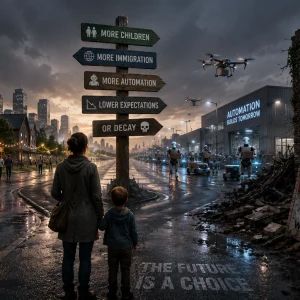
Eventually, every low-birth society faces a menu it may not like.
More children.
More immigration.
More automation.
Lower expectations.
Or decay.
Those are the choices. There may be different mixtures, better policies, smarter timelines, and softer landings, but there is no magic sixth option where fewer young workers support more old people, maintain the same infrastructure, provide the same services, reject new machines, reject new energy, reject new housing, reject new arrivals, and somehow keep everything humming.
That is not a plan. That is nostalgia with a spreadsheet.
A Loud Messenger
Elon Musk has been unusually loud about this problem, warning that “population collapse due to low birth rates is a much bigger risk to civilization than global warming.”3 He is a polarizing messenger, which means some people hear the quote and immediately begin arguing about him instead of the underlying issue. That is understandable. It is also a convenient way to dodge the math.
The demographic trend does not care who noticed it.
And Musk is not only talking about babies. He is also building toward the other side of the equation: robots. Tesla describes Optimus as a “general purpose, bi-pedal, autonomous humanoid robot” intended to perform unsafe, repetitive, or boring tasks.4 Whether Tesla succeeds on its timelines or not, the direction is obvious. The richest companies in the world are not casually dabbling in humanoid robotics because they ran out of ways to make phone apps. They see the same gap forming.
Aging societies will need labor that does not exist yet.
Some of it may come from immigration. Some of it may come from people working longer. Some of it may come from better wages pulling workers into jobs that were treated as disposable for too long. Some of it may come from families deciding, or being able, to have more children.
Machines Fill the Gap
But some of it is going to come from machines.
Not because machines are magical. Not because every humanoid robot demo should be believed. Not because every kiosk, app, chatbot, or robot arm improves life. Plenty of automation is terrible. Some of it feels like a company fired three humans and replaced them with a touchscreen that needs therapy.
But the pressure behind automation is real.
When there are not enough people to stock the shelves, the shelf-stocking robot starts looking less like a gimmick. When nursing homes cannot find enough aides, assistive robotics starts looking less like science fiction. When warehouses cannot fill shifts, robotic picking systems look less optional. When a rural town cannot keep enough staff at the counter, the kiosk appears. When call centers cannot afford enough humans, the AI voice arrives, cheerful as a hostage note.
People complain about this, often correctly. They miss the human being. They hate the app. They want the person behind the desk back.
Fair.
But the person behind the desk has to come from somewhere.
An Equation That Does Not Balance
This is where the anti-data-center, anti-energy, anti-automation mood runs into a wall. A society cannot simultaneously demand modern comfort, shrinking labor, less immigration, fewer children, no robots, no AI, no data centers, no new power generation, no new transmission lines, and no decline in service.
That equation does not balance.
If you want more human workers, you need a society where people can actually build families. That means housing that does not feel like a prank. Wages that can carry more than survival. Childcare that does not eat a second mortgage. Communities where people trust the future enough to populate it.
If you want fewer human workers but the same level of service, you need automation. That means data centers, chips, power, software, robotics, factories, maintenance, and the ugly industrial backside of the clean little interface.
If you want neither, then what you are asking for is decline with nicer language.
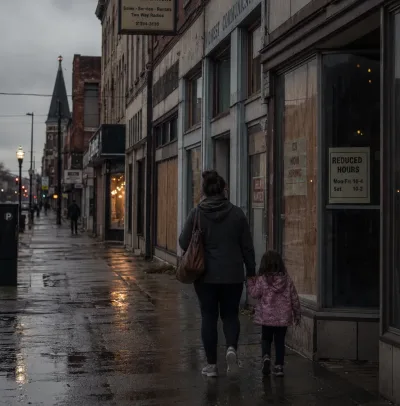
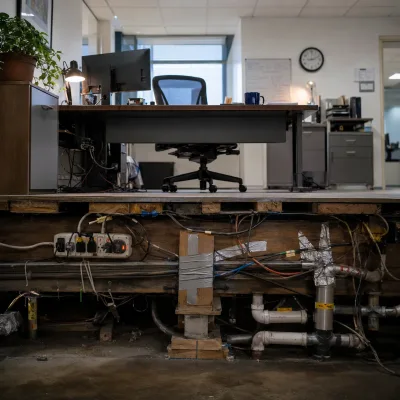
The grocery store closes earlier. The hospital wait gets longer. The local diner loses its breakfast shift. The nursing home is understaffed. The school district consolidates. The potholes stay longer. The help desk becomes a maze. The county office is open three days a week. The old technician retires, and nobody knows why the system only works when that one box stays plugged in.
This is the entropy version. Not the dramatic apocalypse poster. Just the slow removal of capacity.
Children and Robots Together
The strange thing is that children and robots are often discussed as opposites, as if one belongs to the warm human past and the other to the cold mechanical future. But in a functioning civilization, they may end up needing each other.
Children are not just future workers. That would be a grim little factory-owner way to think about human life. Children are meaning, family, continuity, memory, and the unreasonable belief that the world should continue after us.
Robots are not just replacements. At their best, they are tools that can take weight off human beings. They can do dangerous, repetitive, exhausting, boring, backbreaking, lonely, or high-precision work. They can extend the reach of a smaller workforce. They can help older people remain independent. They can keep some systems functioning when the human layer gets thin.
The question is not whether we should have children or robots.
The question is whether we are still serious enough as a civilization to make either future work.
Because both require confidence.
Having children requires confidence that tomorrow is worth entering. Building robots requires confidence that tomorrow is worth engineering. Both require energy, sacrifice, infrastructure, and long-term thinking. Both are acts of defiance against decline.
Ruins require much less effort.
That is their advantage.
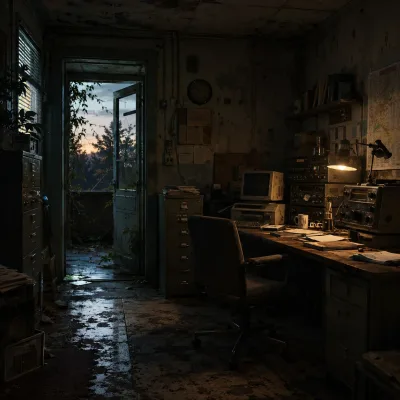
You do not have to build a ruin. You can simply stop maintaining a civilization and wait. Time will do the rest. The roof will soften. The sign will fade. The office will close early. The help wanted notice will yellow in the window. The road will crack. The school will empty. The file cabinet will rust shut around paperwork nobody remembers needing.
Entropy is patient. It has excellent attendance.
Honest About the Alternative
So when people argue against every new data center, every new power plant, every new factory, every robot, every warehouse, every housing development, and every attempt to make family formation easier, they should at least be honest about the alternative.
Maybe they imagine a simpler world. A slower world. A more human world.
That is not a foolish desire. There is something deeply understandable in wanting less noise, less churn, less corporate machinery, less ugly expansion, less of the future arriving as a construction zone.
But a smaller, older society does not automatically become a cozy village. It can also become a place where nothing works after 5 PM, nobody can afford children, the young leave, the old wait, and every institution survives by lowering expectations one notch at a time.
There is a difference between simplicity and depletion.
A healthy small town is not the same as a hollowed-out one. A quiet street at dusk is not the same as a street where all the lights are off because nobody could keep the businesses open. A slower life is not the same as a failing system.
That distinction matters.
A Messy Future
The future probably will not be solved by one answer. It will be messy, because all real futures are. Some places will choose immigration. Some will choose family policy. Some will choose automation. Some will choose all three. Some will choose none and call it preservation until the decline becomes too obvious to rename.
But the core truth remains:
A low-birth society has to choose who, or what, will carry the load.
It can be more children.
It can be more newcomers.
It can be more machines.
It can be fewer promises.
Or it can be ruins.
Not cinematic ruins. Not romantic ruins covered in ivy and golden light. Real ruins. The kind that begin as reduced hours, missing staff, delayed repairs, unanswered calls, and empty chairs.
Children, robots, or ruins is not a slogan. It is a systems diagram with a bad attitude.
A civilization can have more families, more automation, more immigration, or fewer expectations. What it cannot have is fewer people, fewer tools, fewer builders, fewer caregivers, less energy, less infrastructure, and the same comfortable life forever.
The machine will not care what we intended.
It will simply ask who is available.
And if nobody answers, it will begin turning itself off one light at a time.
Discussion