The World Is Held Together by Temporary Fixes
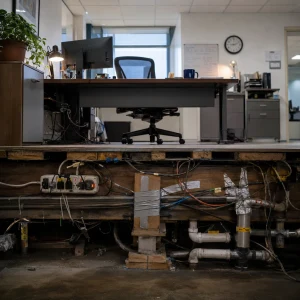
Behind every smooth interface is a basement full of patches, passwords, and people who remember which button not to press.
Civilization is not a marble temple.
It is a stack of temporary fixes that accidentally became permanent.
Somewhere, right now, a billion-dollar process depends on a spreadsheet named FINAL_FINAL_v7.xlsx, a server nobody wants to reboot, a password only one person remembers, and a guy named Dave who retired in 2019.
That is not a joke. Not entirely.
Behind the Interface
The world we live in likes to present itself as smooth, modern, intelligent, and inevitable. Tap the screen, swipe the card, submit the form, scan the code, board the plane, refill the prescription, file the claim, transfer the money. Everything feels clean from the outside.
But behind the interface, there is always a basement.
There are old systems talking to older systems. There are processes nobody fully understands anymore. There are emergency patches from ten years ago that became standard procedure. There are institutions running on software that was outdated before half the current staff was hired.
And somehow, most of the time, it works.
Not because it is perfect.
Because people keep catching it before it falls.
That is the part we forget. The real machinery of the world is not just code, concrete, money, law, or policy. It is maintenance. It is memory. It is the person who knows which button not to press. It is the technician who sees the warning light before the executives see the outage. It is the nurse, the mechanic, the dispatcher, the sysadmin, the clerk, the lineman, the operator, the old-timer, the quiet expert, the one who knows the system is lying when it says everything is fine.
Entropy begins where maintenance ends.
A bridge does not collapse because gravity suddenly became ambitious. It collapses because time was always working, water was always seeping, metal was always rusting, budgets were always shrinking, and everyone kept saying they would get to it next year.
The same is true of software. And governments. And relationships. And bodies. And cities. And memories.
Nothing stays whole by accident.
Everything requires tending.
But we are living in an age that mistakes automation for permanence. We assume that because something has a dashboard, it has a soul. Because it has alerts, it has awareness. Because it has scale, it has strength.
Yet the more complex a system becomes, the more fragile its hidden dependencies become. The more polished the front end, the more terrifying the back room might be.
That does not mean the world is doomed.
It means the world is alive.
The World Is Alive
A living system is always decaying and repairing itself at the same time. Cells die. Skin sheds. Forests burn and regrow. Old ideas rot into soil for new ones. Machines fail. People improvise. The fix becomes the feature. The workaround becomes the tradition.
This is where entropy becomes interesting.
Not as apocalypse. Not as despair. Not as some lazy fantasy about everything falling apart.
Entropy is the pressure underneath all things. The slow pull toward disorder. The reminder that nothing remains untouched by time. But it is also the condition that makes transformation possible.
A perfectly frozen world would never decay.
It would also never grow.
So maybe the real question is not whether things are falling apart.
They are.
They always have been.
The better question is what grows in the cracks, who notices the strain, and what kind of people we become while trying to keep the lights on.
Because the world is held together by temporary fixes.
And for now, we are among them.
Discussion