The People Moving by Literal Horsepower
The Amish, modernity, and the strange power of refusing to accelerate with everyone else.
The Amish are not frozen in time, even if that is how the modern world often prefers to imagine them. They are not museum people. They are not cosplay farmers living inside a postcard. They are a living culture making deliberate choices about speed, technology, family, work, and community while the rest of us keep installing updates we did not read.
That may be the most interesting thing about them. They are not simply “anti-technology.” They are selective. They ask a question most of modern society forgot how to ask: what will this tool do to us?
The Question We Forgot
The rest of us usually ask whether something is faster, cheaper, easier, smarter, newer, or more convenient. We rarely ask what it does to attention, memory, family, patience, community, skill, humility, dependency, or the shape of a human day. If a device saves time, we call it progress, then immediately spend the saved time being available to more devices. Very efficient. Very stupid. Very us.
The Amish move differently. Not perfectly, not uniformly, and not without internal tensions, but differently. Some communities allow certain tools for work but not the home. Some use phones in limited ways. Some hire drivers. Some use solar panels, batteries, pneumatic tools, diesel engines, or modern equipment with restrictions. The details vary, but the principle is more important than the gadget list: technology is not treated as destiny.
That alone makes them feel almost alien in the modern world.
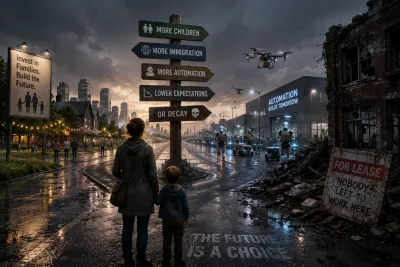
Most of us live as if every new system must eventually be accepted. Smartphones, apps, cameras, subscriptions, remote monitoring, social media, automation, tracking, algorithmic feeds, smart appliances, smart cars, smart doorbells, smart thermostats, smart nonsense. The modern assumption is that if a technology exists, resistance is temporary and adoption is inevitable.
The Amish stand in the road and say: maybe.
Not no to everything. Not yes to everything. Maybe.
That little maybe is more radical than it looks.
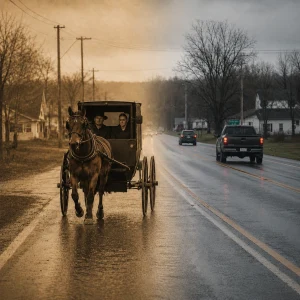
In an age of acceleration, slowness becomes a kind of rebellion. A horse and buggy on the shoulder of a highway is not just a transportation difference. It is a visible argument about time. The cars scream past at seventy miles an hour, sealed in glass, guided by GPS, connected to satellites, financed by debt, tracked by insurance apps, and warmed by heated seats. The buggy keeps rolling at the pace of hooves, weather, distance, and daylight.
Beside Us, Not Behind Us
To the modern eye, this looks backward.
But maybe backward is not always the right word. Maybe some cultures are not behind us. Maybe they are beside us, moving on a different clock.
That does not mean the Amish world is some flawless alternative. No human society gets to be romanticized for free. There are pressures, contradictions, hardships, restrictions, and things outsiders would not want. Communities can protect, but they can also constrain. Tradition can preserve wisdom, but it can also preserve unfairness. Simplicity is not automatically purity. A plain coat does not make a plain soul.
Still, the Amish reveal something uncomfortable about the rest of us:
much of what we call freedom looks suspiciously like dependency with a better interface.
We are free to go anywhere, but many of us cannot sit still. We are free to talk to anyone, but often know our neighbors less. We are free to access endless information, but remember less of what matters. We are free to buy tools that save labor, then work more to pay for them. We are free to be connected constantly, which is another way of saying we are rarely unreachable.
The Amish have their own limits, but they also expose ours.
Controlling What Enters
From an entropy perspective, their way of life is fascinating because it does not try to defeat decay through endless novelty. It tries to slow the rate of social unraveling by controlling what enters the system. Modern society absorbs everything, then wonders why the room is on fire. The Amish inspect the match before letting it near the curtains.
That may be their deeper lesson. Not that everyone should become Amish. Most of us would last about forty-eight hours before missing air conditioning, hot showers, online banking, and the ability to complain about modernity from a glowing rectangle. But there is wisdom in asking what a tool costs beyond money.
What does it do to the family table? What does it do to the child’s imagination? What does it do to work, courtship, attention, silence, sleep, privacy, memory, and community? What does it make easier, and what does it make weaker? What does it replace that we may not know how to rebuild?
The Amish are not outside entropy. Nothing is. Their communities change too. Roads widen. Land prices rise. Outsiders encroach. Young people leave or stay. Rules adapt. Businesses evolve. The modern world presses in from every direction, honking politely or not so politely from behind them.
But they have done something rare. They have kept a hand on the brake.
That brake may not save them from every change, but it gives them time to decide what kind of people they are becoming. The rest of us often discover what technology has done to us only after the update is complete and the rollback button is gone.
A buggy moving through a modern town can look like the past refusing to leave.
It may also be the future asking why we were in such a hurry.