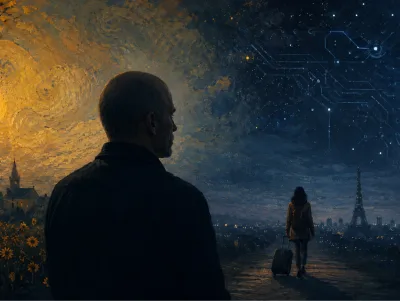
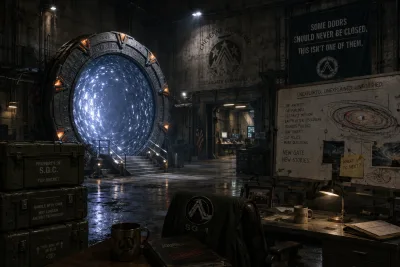
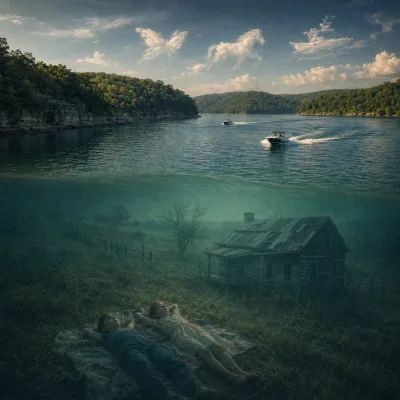
UAPs, Aliens, Dead Worlds, and Something Else
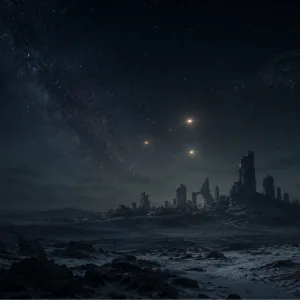
We keep looking at the sky as if it owes us a confession—and the unknown still has weight after the noise fades.
We keep looking at the sky as if it owes us a confession. A light moves wrong. A pilot sees something he cannot explain. A sensor records something that refuses to behave like a plane, a balloon, a bird, or weather. Then the arguments begin. Aliens. Drones. Secret programs. Hoaxes. Dimensions. Demons. Visitors. Noise.
Maybe some of it is nothing. Maybe most of it is nothing. Misread sensors, classified aircraft, atmospheric oddities, human error, folklore, wishful thinking, and the old instinct to turn shadows into monsters. That all has to be admitted up front, because without that admission the whole subject becomes too easy to dismiss.
But even after the noise is stripped away, the phenomenon remains interesting because of the size of the darkness around it. The unknown is not proof of anything, but it is still unknown. That matters. It is one thing to say we do not have evidence for a particular answer. It is another thing to pretend the absence of an answer means the question has no weight.
The UAP question may not be about little green men or saucers or government hangars full of impossible machines. It may be about humility. It may be about the uncomfortable realization that human civilization is very young, very loud, and very confident for something that has only recently learned to listen.
The Brief Moment We Became Visible
For a brief moment in our history, we became visible. Radio towers, television broadcasts, radar, analog leakage, open signals spilling out from the surface of the Earth and moving into the dark at the speed of light. We imagine this made us detectable, and maybe it did. But almost as quickly as we began shouting, we began pulling our voices back into wires, fiber, cable, narrow beams, encrypted packets, satellites, closed networks, and buried infrastructure.
Maybe technological civilizations do not stay loud for long. Maybe radio leakage is not the permanent signature of intelligence, but a short adolescent phase. A century-long cough in the night. We assume that if others are out there, we should hear them. But that assumption may say more about our own moment than it says about the universe.
Maybe the silence does not mean absence. Maybe it means civilizations eventually stop screaming.
Civilizations at Different Points
Across the cosmos, if life and intelligence are not unique to Earth, then civilizations would not all be standing at the same point in the road. Some may be just beginning. Some may be discovering fire, agriculture, writing, mathematics, chemistry, electricity, radio. Some may be where we are now, staring into screens, building networks, compressing their lives into data, and wondering whether the strange things in their own skies are visitors, weapons, weather, or gods.
Others may be far older. Some may have passed through their renaissance, their industrial age, their digital age, and into something we would not recognize as civilization at all. Some may have survived their chaos. Some may not have. There may be dead worlds out there with empty cities under alien dust, machines still running beneath cracked domes, satellites still orbiting planets whose languages are gone.
If anything ever crossed the dark to reach us, it might not come as conquerors or saviors. It might not even come as living beings. It could be machines, probes, survey systems, old instructions still executing long after the hands that wrote them became fossils. A dead civilization’s last habit, still moving.
Or maybe they would be refugees. Not invaders. Not gods. Not angels. Refugees from planets burned, frozen, stripped, poisoned, abandoned, or simply exhausted by time. The universe is old enough for homes to die. It is old enough for civilizations to bury their beginnings and flee their endings. If life has happened elsewhere, then loss has happened elsewhere too.
And maybe the strangest possibility is that “elsewhere” does not only mean another star. Maybe distance is not the only barrier. Maybe there are structures of reality beside ours, beneath ours, folded through ours, or touching ours in ways we do not yet have the language to describe. That does not have to mean magic. It may only mean that our physics is unfinished, and that our common sense is provincial.
An Incomplete Map
That is the part worth sitting with. Not belief. Not certainty. Not the cheap thrill of pretending every strange light is a visitor. Just the recognition that our map is incomplete.
We are a young species on one planet, inside one temporary climate, during one narrow technological phase, trying to interpret the sky with brains built for weather, predators, fire, and faces in the dark. Maybe UAPs are human technology. Maybe they are sensor ghosts. Maybe they are natural phenomena we have not yet categorized. Maybe they are something else entirely.
We do not know.
That is the uncomfortable part.
And maybe the honest part.
The sky does not owe us an answer. But it keeps leaving room for questions.