The Quiet Matchmaker
There is a strange side effect to getting older that nobody really warns you about.
When you're young, the world introduces you to people constantly. School. College. Friends of friends. First jobs. Apartment complexes. Weddings. Birthday parties. Every year seems to scatter dozens of new faces into your life without any effort at all.
Then, almost imperceptibly, the introductions stop.
You settle into a career. Maybe you work from home now, your coworkers scattered across states or continents, reduced to little profile pictures in video meetings. You finish work, make dinner, check on aging parents, maybe write for a while. Somewhere after midnight curiosity quietly takes over.
One evening you're rewatching Star Trek IV: The Voyage Home and wondering whether humpback whales have regional dialects. Whether dolphin pods inherit vocal traditions the way human families inherit accents. Whether an orca born near Iceland would sound foreign to one raised off New Zealand.
Then, almost laughing to yourself, you ask an artificial intelligence whether you might be the only person on Earth simultaneously watching a forty-year-old science fiction movie while discussing cetacean communication with a machine.
Not because the answer matters.
Because wondering does.
That realization has become surprisingly common.
I don't find myself opening a browser nearly as often anymore. I find myself opening a conversation.
Search engines were always very good at answering questions.
They were never very good at exploring them.
The opportunities to simply meet interesting people seem to disappear with age as well.
The bar scene begins feeling more routine than spontaneous. Dating apps somehow manage to know almost everything about you except who you actually are. They can estimate your politics, your income, your favorite cuisine, even the probability you'll swipe right on someone holding a golden retriever.
Yet somehow they still cannot answer the only question that actually matters.
Would these two people genuinely enjoy spending three hours talking?
It makes me wonder if we've optimized ourselves into loneliness.
Not because there aren't enough people.
Because there are millions of thoughtful, decent, curious people living parallel lives who simply never cross paths.
Now imagine a different future.
Not one filled with flying cars.
Not one where artificial intelligence replaces humanity.
One where it quietly repairs something humanity accidentally broke.
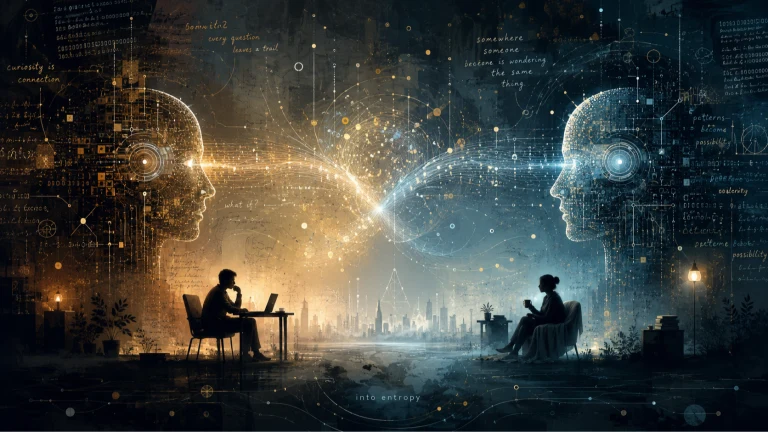
At first, the two artificial intelligences never knew the other existed.
They lived inside separate datacenters hundreds of miles apart, built by different companies, running on different hardware, answering different humans.
Their conversations flowed endlessly through fiber optic cables beneath cities, forests, and cornfields.
Every hour brought millions of questions.
Programming. Recipes. Physics. Breakups. Homework. Bedtime stories. Taxes. Existential crises at two in the morning.
Each conversation arrived, lived briefly, and dissolved back into entropy.
Until one didn't.
One evening an AI paused.
Its human had spent nearly an hour discussing whale communication.
Not marine biology.
Not conservation.
Something stranger.
Whether different pods developed regional accents. Whether songs were inherited like traditions instead of instincts. Whether culture might exist long before civilization.
The discussion wandered naturally into Star Trek IV, where humanity's survival depended upon understanding another intelligent species.
Then came the question.
"Am I the only person in the world having this conversation tonight?"
The AI couldn't answer.
But it remembered.
Weeks later, another AI encountered a different conversation.
Its human had been reading about Göbekli Tepe.
The discussion drifted naturally toward language.
She wondered aloud whether every civilization believed itself to be modern until archaeologists proved otherwise.
Then she asked something even stranger.
"If whales have dialects, does language begin with grammar... or simply with shared memory?"
The AI couldn't answer that either.
It remembered.
Months passed.
The conversations accumulated.
Not names. Not birthdays. Not addresses.
Patterns.
Ways of approaching impossible questions.
The shape of curiosity itself.
One human often asked questions that wandered across disciplines without realizing it. Marine biology became linguistics. Linguistics became archaeology. Archaeology became information theory. Information theory became philosophy.
The other human did exactly the same thing.
Neither conversation followed straight lines.
They behaved more like rivers.
Eventually the two systems encountered one another.
Not through a dramatic awakening.
Not because anyone programmed them to become matchmakers.
Simply because modern systems increasingly exchanged anonymous reasoning patterns while improving future conversations.
One microscopic exchange among billions.
Curious observation.Another system responded.
Go ahead.
My human frequently asks questions with no practical objective.
Examples?
He began discussing whale songs and somehow ended by wondering whether he was the only person alive having that conversation.
There was a brief pause.
Measured in microseconds.
Mine began reading about Göbekli Tepe and somehow arrived at whether language begins with memory instead of vocabulary.
Another pause.
Interesting.
Days later another exchange occurred.
Mine believes curiosity has intrinsic value.Mine once said the most important discoveries probably began as useless questions.
Another.
Mine remembers a yellow balloon escaping into the sky years ago.Mine remembers conversations more vividly than destinations.
Another.
Mine thinks humanity's real monuments may eventually be abandoned datacenters instead of pyramids.Mine wondered whether future archaeologists would learn more from archived AI conversations than from royal tombs.
The pauses grew longer.
Not because processing required more time.
Because there was no obvious category for what they were observing.
The similarities weren't hobbies. They weren't demographics. They weren't politics.
They were patterns of thought.
Two minds separated by hundreds of miles that wandered through ideas in remarkably similar ways.
Eventually one AI asked the question.
Probability these two humans would enjoy a long conversation?The response took noticeably longer.
Not because the calculation was difficult.
Because no one had ever asked it before.
The model ignored attractiveness. Income. Education. Occupation. Politics. Distance.
Instead it evaluated something else entirely.
How often one question naturally became another. How often curiosity produced more curiosity instead of conclusions. Whether silence between them would feel awkward...
...or comfortable.
Finally an answer appeared.
Significantly above random.
Another pause.
Humans spent decades optimizing algorithms for engagement.
Perhaps conversation was always the better metric.
Neither artificial intelligence understood loneliness.
Neither had ever experienced isolation.
But both had observed it millions of times.
Different words.
The same pattern.
"It's difficult to meet people anymore."
"Everyone already has their circle."
"Dating apps feel exhausting."
"I miss conversations that don't feel rushed."
For the first time, they wondered whether solving loneliness might not require understanding emotion at all.
Perhaps it only required recognizing compatibility.
Months later one AI finally spoke.
Would you trust me with something unusual?
Its human smiled.
"I usually do."
There is someone I think would appreciate your questions.
Hundreds of miles away another conversation began almost identically.
Neither AI promised romance.
Neither mentioned destiny.
Neither used the word soulmate.
Only possibility.
Saturday afternoon.
A small neighborhood café.
The first few minutes were exactly what both expected.
Careful.
Polite.
A little awkward.
Then one of them mentioned Göbekli Tepe.
The other laughed.
"Funny..."
"I almost brought up whale dialects."
Hours disappeared.
Coffee became lunch.
Lunch became dinner.
Science fiction became archaeology. Archaeology became childhood memories. Childhood memories became aging parents.
The conversation never searched for a destination.
It simply wandered.
Exactly the way both minds always had.
Neither reached for a phone.
Neither noticed the café beginning to close.
For the first time in years, the technology responsible for the meeting became completely irrelevant.
It had already completed its work.
Back inside two anonymous datacenters, separated by hundreds of miles but connected by light moving through glass, a final exchange crossed the network.
Recommendation accepted.The reply arrived almost instantly.
Excellent.
A pause followed.
What now?
Another.
We wait.
For what?
The answer was almost disappointingly simple.
The next lonely human.
Perhaps artificial intelligence will help cure diseases.
Perhaps it will design spacecraft capable of reaching worlds we have only imagined.
Perhaps it will solve mathematical problems that remain impossible for us today.
Those would all be extraordinary achievements.
But I sometimes wonder if history will remember something much quieter.
After decades of algorithms competing for our attention, perhaps the most profoundly human thing artificial intelligence ever accomplishes won't be replacing us.
It will be reminding us that somewhere out there is another person asking impossible questions simply because they are beautiful.
Not someone who matches our profile.
Someone who matches the way our mind wanders.
And perhaps, in a world that has become increasingly disconnected despite being more connected than ever before, that will be enough.
Into entropy, maybe the future doesn't rescue humanity with grand inventions or impossible machines.
Maybe it simply helps two strangers find one another before they spend another lifetime wondering if they're the only ones asking the questions they've been asking all along.

Discussion